

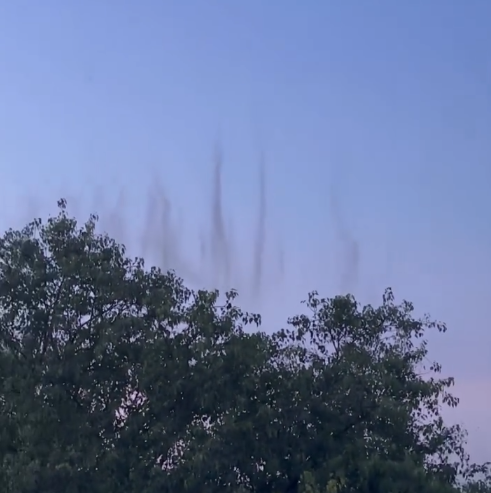
Hyderabad: What looked like columns of smoke rising mysteriously behind a row of trees in Uppal turned out to be something far less dramatic—but considerably more unpleasant for residents: large swarms of mosquitoes hovering over the trees at twilight.
The unusual sight was captured on camera by Uppal resident Monica Juyal a few days ago. The footage, showing dense, wave-like formations moving above the trees, quickly made its way onto social media. At first glance, the formations appeared almost like smoke or steam rising into the evening sky. A closer look, however, revealed that the strange clouds were actually made up of flying insects.
The video has since triggered a wider conversation among Hyderabad residents about mosquito breeding, stagnant water and the effectiveness of preventive measures in areas where open spaces, drains, water bodies and construction activity exist in close proximity to residential colonies.
Why do mosquitoes gather like this?
Such dramatic formations can occur during the breeding and mating cycle of certain flying insects. Male mosquitoes and other insects may gather in large numbers around prominent visual landmarks such as trees, particularly during twilight hours.
While the sight may look unusual, residents say the sheer density of insects in the Uppal area has renewed concerns about mosquito control, particularly around vulnerable water bodies and open spaces.
Local residents have pointed towards Uppal Nalla Cheruvu and surrounding areas as locations requiring greater attention. Water accumulation, drains and construction-related pockets can create favourable conditions for mosquito breeding if they are not regularly treated or cleared.
The viral footage has therefore done more than surprise social media users. It has brought an everyday urban problem back into focus: how effectively is mosquito breeding being controlled in Hyderabad?
What can GHMC do?
Mosquito control in urban areas generally involves a combination of source identification, anti-larval treatment and fogging.
View this post on Instagram
The GHMC entomology teams identify potential breeding sources such as stagnant drains, polluted water bodies, construction sites and other water-accumulation points. Anti-larval operations are then undertaken in areas where mosquito larvae are found, while fogging and other spraying measures are used to target adult mosquitoes.
Residents in Uppal have urged municipal authorities to step up these activities and conduct regular interventions rather than relying only on short-term measures after mosquito numbers become visibly high.
The ‘oil ball’ method
One of the traditional tools used in mosquito-control operations is the oil ball.
These are generally prepared using pieces of gunny material or cloth stuffed with sawdust and formed into compact balls. They are then soaked in mosquito larvicidal oil or, in some operations, oil-based substances before being placed in stagnant water.
The objective is to create a thin film over the surface of the water. Since mosquito larvae need to come to the surface to breathe, the oil film can interfere with their access to air and help control larvae.
The method is particularly associated with the treatment of suitable stagnant-water locations where mosquito breeding is taking place.
Drones join the mosquito-control battle
Mosquito control has also adopted technology.
A few months ago, the GHMC entomology wing used drones for spraying larvicides and pyrethroid-based oils over water bodies, particularly in locations where conventional ground-based operations could be difficult.
The use of drones allows mosquito-control personnel to reach larger or inaccessible stretches of water without depending entirely on manual spraying. Such interventions can be especially useful when the breeding source is located in difficult terrain or across extensive water surfaces.
Fish that eat mosquito larvae
Not every mosquito-control method involves chemicals.
Larvivorous fish such as Gambusia can be introduced into suitable freshwater ponds and other water bodies. These fish feed on mosquito larvae and can therefore serve as a form of biological control.
However, such measures need to be applied appropriately to the local environment and water body, rather than being treated as a universal solution.
Fogging is only one part of the solution
Fogging is perhaps the most visible mosquito-control measure from a resident’s perspective. When a fogging vehicle passes through a neighbourhood, the dense spray immediately signals that mosquito-control operations are underway.
But controlling mosquitoes effectively requires more than killing adult insects. The breeding source itself has to be identified and treated.
That means removing stagnant water, treating mosquito larvae, clearing blocked drains and addressing water accumulation around construction sites and residential areas.
This is also where public participation becomes crucial.
What residents can do
Health authorities have repeatedly advised citizens to take simple precautions to reduce mosquito breeding and prevent bites.
Residents are advised to:
- Keep doors and windows closed or use mosquito screens where possible.
- Use mosquito nets, particularly for babies and young children.
- Use mosquito repellents as an additional precaution.
- Ensure that domestic drains are properly maintained.
- Keep septic tanks securely covered with mesh to prevent mosquitoes from entering and breeding.
- Regularly empty containers, tyres, flowerpots and other objects that can collect stagnant water.
- Observe a weekly ‘Friday Dry Day’, clearing stagnant water from around homes and residential premises.
The Telangana health authorities have also stressed the importance of community participation in preventing mosquito-borne diseases.
A viral video with a serious message
The Uppal mosquito-swarm video may have begun as a curious evening recording, but its rapid circulation has given residents an opportunity to draw attention to a much more familiar urban concern.
For many Hyderabadis, mosquitoes are an everyday nuisance. But when large swarms become visible over residential areas, the issue becomes difficult to ignore.
The strange-looking ‘smoke’ over Uppal has therefore turned into an unexpected reminder: effective mosquito control begins long before the fogging machine arrives.
For civic authorities, that means keeping a close watch on breeding sources. For residents, it means eliminating stagnant water wherever possible.
And for Hyderabad’s neighbourhoods, the message is simple—when the mosquitoes become visible in clouds, the problem may already be much bigger than a single evening swarm.