

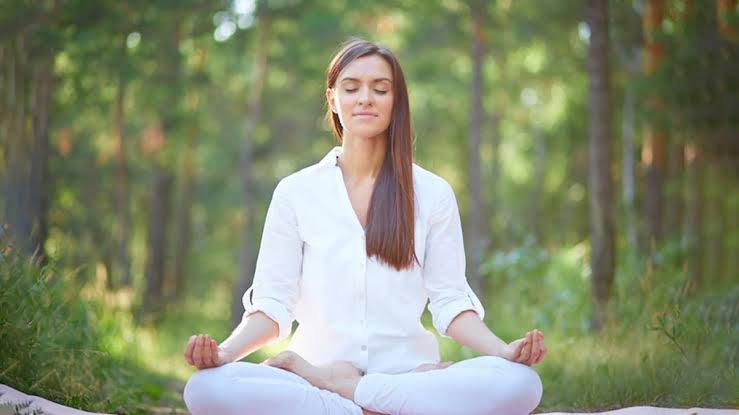
How Breath, Mindfulness and Ancient Yogic Practices Can Nurture Physical and Mental Well-being
The word pranayama can be broadly divided into two segments. Prana implies the vital source of energy (the subtle life force), and yama is the control, extension or expansion. Therefore, pranayama can be understood as the extension of this dimension of prana.
When our energy, or prana, or chi levels are low, we feel enervated. This invariably occurs when we eat in large proportions rather than partake of smaller, more suitable quantities, either sleep excessively or do not have adequate rest. In all such cases, there is a significant expenditure of the vital life force. In these testing times, replenishing doses of energy are paramount.
Energy can be replenished through the regular practice of pranayama, yoga and meditation. This fortifies the flow of prana through the nadis, or energy channels, in the human body and supports our immune system.
Depletion of energy takes place on account of disruption in our lifestyle, dietary indiscretions, emotional upheavals, or lack of physical exercise, besides the human mind undergoing unnecessary stress as it is relentlessly bombarded with information about the recent spike in cases of H1N1.
The human body becomes weak and depleted of energy when we compromise on the four vital sources of energy. These are essentially food, breath, rest and a calm and meditative state of mind.
Negligence on our part leads to excessive pressure on the body and mind, thereby weakening the immune system of the body. These days, there is so much talk about increased inflammation in the body, which results in various ailments.
When the human mind is not in the present moment, it oscillates like a pendulum between the past and the future and invariably feels distressed and distraught. Consequently, our breathing pattern becomes rapid and shallow.
Proper breathing acts like a tonic in manifold ways. It strengthens the immune system, recharges our depleted batteries, assuages an overwrought mind and helps us live in the present moment.
Thus, there is a deep and subtle connection between the breath, body and mind. Effective and rhythmic breathing ensures that we live in the present, keeping the mind calm, collected and in a meditative state. In such a state, positive endorphins are released and the body is healthy and robust enough to combat disease.
Through the regular practice of pranayama and breathing techniques such as Sudarshan Kriya, the mind gets entrenched in the present moment. The human body is powered by five primordial elements: earth, water, fire, air and space. These are all extremely important, interwoven and interrelated, but it is vayu (air) that sustains our life. We can be without food or water for a few days, but cannot survive without breathing.
Our ancient rishis have succinctly opined that pranayama is nothing but the worship of Vayu Devata, or the Wind God. The powers of vayu are immense and were known to our ancestors and the rishis. No wonder we pray to Lord Hanuman during our trials and tribulations. He is the closest to Narayana, nourishes and sustains us, and strengthens our bodies physically and mentally.
Yoga is a much-misunderstood word. It is assumed to be merely a set of physical exercises. That is an incorrect perception. Yoga in Sanskrit actually means yuj (that is, the union with the self and the divine). Yoga transcends to the metaphysical and is not merely confined to the realm of the physical plane.
These are keys to balanced physical and mental health. Fortuitously, the generation today is increasingly being exposed to the secrets of breath, and this is a positive development.
“Breathing in, I calm body and mind. Breathing out, I smile. Dwelling in the present moment, I know this is the only moment,” says the spiritual master and writer Thich Nhat Hanh.
Yogic Science of Mudras
Lord Krishna in the Bhagavad Gita says, “There is nothing as sacred as knowledge.” Knowledge can be acquired by the human mind through the 5 Ds — dedication, determination, dynamism, devotion and discipline — and one H: humility.
The human mind can harness this potential only if it is in the present moment and not in a fragmented state. By practising proper breathing techniques, like Sudarshan Kriya and Nadi Shodhan Pranayama (alternate nostril breathing), and through regular meditation, the mind becomes wakeful and alert to delve deep into this knowledge.
It is indeed salutary and efficacious to learn about mudras. The practice of mudras is not just in the domain of dancers, painters and artistes; even individuals who have nothing to do with the art world ought to learn about mudras.
The science of mudras is intrinsically related to the esoteric knowledge of yoga, which can be further segregated into the five elements, the five life forces (or subtle forces of energy called the pranas) and the three doshas.
The five elements are namely — Akash (ether or space), Vayu (air), Agni (fire), Jal (water) and Prithvi (earth). The five life forces or pranas are Prana, Udana, Samana, Apana and Vyana, and the three doshas are vata, kapha and pitta.
Humans unconsciously practise mudras. For instance, the Namaste Mudra, or a young child beginning to learn to walk with his thumbs raised, is called the Meru Dand Mudra. In an infant in deep slumber, the index finger would involuntarily touch the thumb while the other three fingers rest at the base of the palm — the Chinmaya Mudra.
The universe, in its auto-mode, conjures these processes to take place, about which we are totally oblivious. Some other mudras which need to be practised are:
(a) Jnana Mudra
This is performed to increase brain power, improve memory and remove negative thoughts, thereby helping one attain peace and bliss.
(b) Prithvi Mudra
This helps in balancing the five sense organs, improves blood circulation and enhances our energy levels. Practising this mudra assists in increasing our alertness.
(c) Apana Mudra
This facilitates an improved elimination process, revitalises the digestive system, improves the gums and strengthens immunity.
(d) Prana Mudra
This mudra addresses the problem of fatigue; it also provides essential vitamins to the body while increasing stamina and vigour. It also helps in maintaining the health of our eyes.
(e) Dhyana Mudra
Essentially, this mudra helps in making us mindful and wakeful, enabling us to be at peace with ourselves. Over a period of time, we attain peace of mind.
(f) Shunya Vayu Mudra
Practice of this mudra helps in combating problems of flatulence and gastric ailments. The gut houses our solar plexus, which is also referred to as the second brain. We need to take adequate care of our abdomen, as a majority of human ailments arise from this part of the body.
Therefore, there is enormous merit in the adage: ‘Health is in your hands.’
ABOUT THE AUTHOR

Ravi Valluri is Advisor, Krishnapatnam Railway Company Limited. He has authored both fiction and non-fiction works and is a faculty member of the Art of Living. His latest work is Glimpses of Grace. He can be reached at valluri.ravi@gmail.com or on WhatsApp at 9618564024.