

Webinar highlights the need for community-centred early warning systems, regional cooperation and coordinated action to reduce the impact of mountain disasters
Hyderabad, September 21: Himalayan hazards may not be entirely preventable, but their consequences can be significantly reduced through stronger community-centred early warning systems, disaster preparedness and sustained cooperation among South Asian countries.
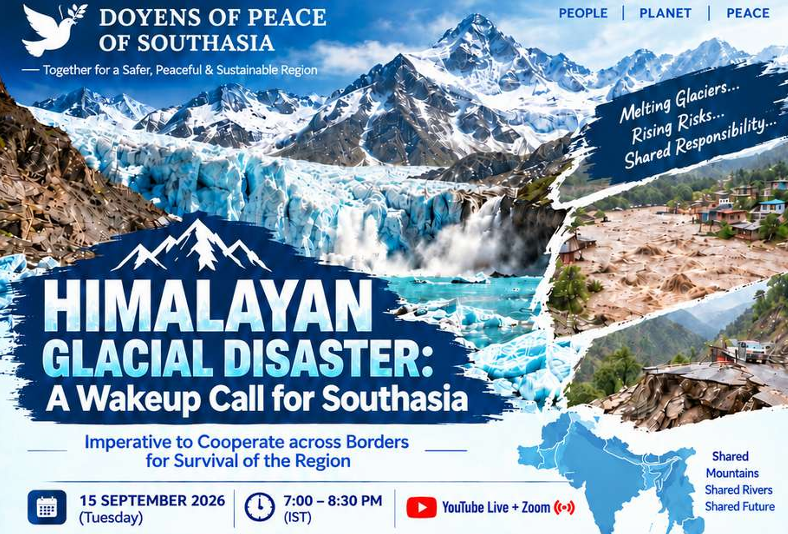
This was the key message emerging from the webinar on “Himalayan Glacial Disaster: Wakeup Call for Southasia”, organised by Doyens of Peace of Southasia on September 15, 2026, as part of its Monthly Meeting Series.
The discussions brought together young experts and senior practitioners from across South Asia to examine the growing complexity of Himalayan disasters and explore practical measures to reduce their human and environmental impact.
Rasuwa disaster highlights growing mountain risks
The recent Rasuwa event in Nepal was highlighted during the webinar as an example of the increasingly complex nature of hazards in the Himalayan region.
Participants emphasised that floods, glacial-related hazards, landslides and other mountain disasters do not respect national boundaries. Consequently, effective disaster preparedness requires not only action within individual countries but also greater regional coordination and information sharing.

Young voices from Pakistan, Nepal and India
Three young panelists from Pakistan, Nepal and India presented perspectives on the causes of recurring Himalayan disasters, gaps in preparedness and the responsibilities of South Asian countries.
The panelists were:
- Dr. Sher Muhammad, ICIMOD, Nepal–Pakistan
- Samir Thapa, General Secretary, Nepal Environment Society (NES)
- Anmol Ohri, Founder Director, Climate Front India
Their presentations focused on three key themes:
- “Recurring Calamities in the Himalayas: Some Key Causes”
- “Rasuwa Floods: Where Did We Miss?”
- “Himalayan Disasters: Responses and Responsibilities of Southasian Countries”
The discussions underlined the importance of strengthening disaster preparedness at the community level and ensuring that early warnings reach vulnerable populations in time.
Senior experts offer perspectives for the way forward
Dr. B. V. Subba Rao from India and Mr. Kanak Mani Dixit of Nepal served as senior discussants. Through their commentaries and critiques, they offered valuable suggestions on strengthening preparedness, improving policy responses and developing greater cooperation across the region.
The discussion between the youth panelists and senior experts was moderated by Lutfa Pathan of Bangladesh and Shahrbanoo Rezayee of Afghanistan.
From awareness to action across borders
The deliberations stressed the need to move beyond awareness and adopt concrete measures to address the risks facing Himalayan communities.
Participants noted that scientific information, early warning mechanisms, community participation and timely coordination between authorities can play a critical role in reducing the impact of disasters.
The webinar also emphasised that regional cooperation is particularly important because the Himalayan ecosystem and its risks extend across several South Asian countries.
Focus on peace, cooperation and regional partnerships
Dr. Mazher Hussain of India made a presentation on “How to Partner with Doyens of Peace”, while Ahmad Raza of Pakistan spoke about an upcoming programme marking International Peace Day on September 21, 2026.
The webinar concluded with reflections by Lalita Ramdas on “Lessons and Leads: Challenges and Opportunities for the Future of Southasia”.
Dema Lhamo of Bhutan proposed the Vote of Thanks, while Aradhya Yadav of Nepal, Lead of the Working Committee for Monthly Meetings, was responsible for the conduct and coordination of the programme.
A call for sustained regional cooperation
The webinar highlighted the urgent need for South Asian countries to strengthen cooperation on disaster risk reduction, climate-related hazards, early warning systems and community preparedness.
While Himalayan disasters cannot always be prevented, coordinated preparedness and timely action can help prevent natural hazards from turning into catastrophic humanitarian crises.
The central message of the webinar was clear: South Asia needs to move from complacency to preparedness and from preparedness to action—“Action Across Borders”.
Watch the Webinar and Access the Proceedings
The live webcast and the eBook containing the proceedings of the webinar are available through the Doyens of Peace of Southasia website:
Himalayan Glacial Disaster – Webinar September 2026 – Peace Doyens
Steering Committee
Doyens of Peace of Southasia
Secretariat: COVA Peace Network
Hyderabad, India
Email: doyensofpeacesouthasia@gmail.com
WhatsApp: +91 9701909370
Website: www.peacedoyens.org