

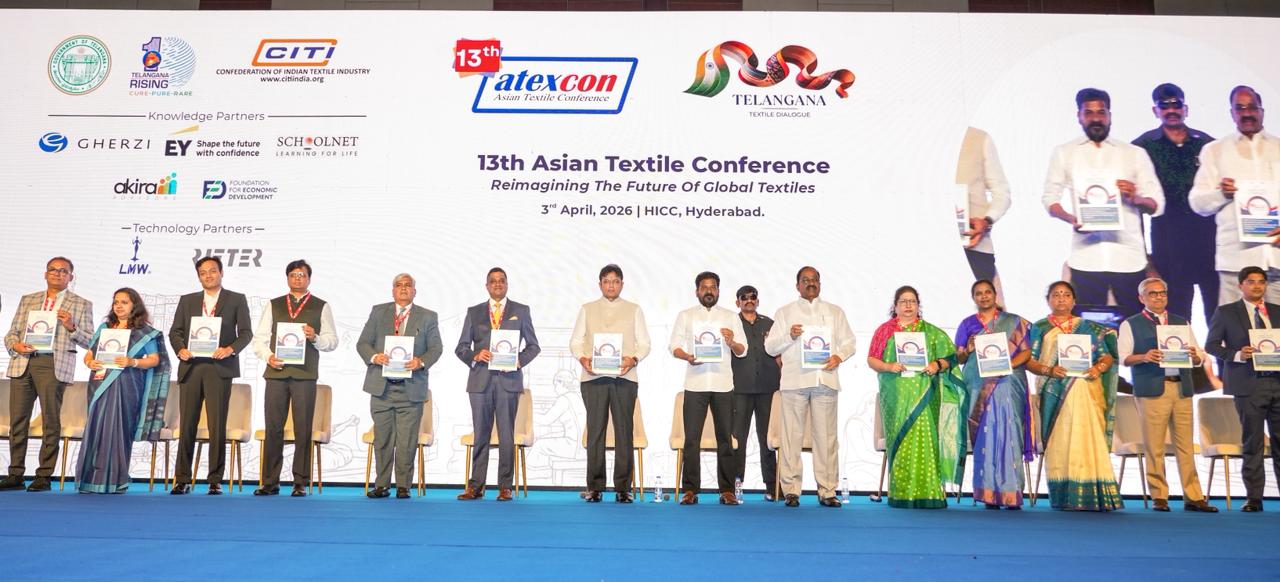
Hyderabad, April 3: Telangana is gearing up to transform itself into the textile capital of South Asia by 2047, with a strong push towards sustainability, global partnerships, and end-to-end value chain development, announced Chief Minister A. Revanth Reddy at the inauguration of the 13th Asian Textile Conference (ATEXCON 2026) in Hyderabad.
The prestigious global summit, jointly organized by the Telangana government and the Confederation of Indian Textile Industry, brought together over 1,200 delegates from across India and international textile hubs.
Addressing the gathering, the Chief Minister outlined a bold vision to position Telangana as a leading global textile destination. “If you have a vision, we are your perfect partners for global success,” he said, inviting investors and industry leaders to collaborate in building a robust textile ecosystem.
Highlighting Telangana’s industrial strengths, Revanth Reddy emphasized that the state offers a competitive advantage through world-class infrastructure, availability of land, uninterrupted power supply, water resources, investor-friendly incentives, and swift project execution. He linked this vision to the broader “Telangana Rising” goal of building a $1 trillion economy by 2034 and $3 trillion by 2047.
The Chief Minister also underscored the importance of human capital, stating that Telangana possesses highly skilled manpower capable of meeting global industry standards. “Our policies match the best globally, but most importantly, we have the best human resources,” he noted.
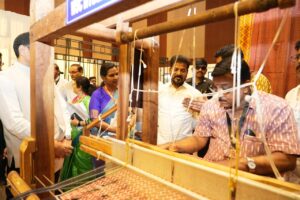
Revanth Reddy highlighted the deep-rooted textile heritage of the state, referring to globally renowned traditional weaves such as Pochampally Ikat, Gadwal sarees, Warangal durries, and Narayanpet fabrics. He stressed that textiles are not merely an industry but a lifeline for thousands of weaving communities across Telangana.
“Telangana is among the largest producers of high-quality cotton in India, known worldwide for its richness and durability,” he said, adding that the state’s strong agricultural base complements its textile ambitions.
Drawing from history, the Chief Minister pointed out that Hyderabad had been a thriving trade center during the rule of the Nizams, attracting global merchants for textiles and pearls. He also highlighted India’s centuries-old tradition of textile craftsmanship, where art and culture played a vital role in shaping world-class fabrics.
On a cultural note, Revanth Reddy shared that as per tradition, he offers ceremonial attire to Lord Sri Rama at the Bhadrachalam Temple during Sri Rama Navami, symbolizing the deep connection between textiles and the region’s cultural identity.
The Chief Minister reiterated that Telangana possesses both the “skill and the will” to lead the textile sector. He cited the development of the Kakatiya Mega Textile Park as a major step toward creating an integrated textile ecosystem, supported by multiple apparel parks across the state.
Expanding on the global vision, Revanth Reddy said Telangana aims to play a significant role across the entire textile value chain—from cotton cultivation to high-end fashion showcased in global cities like London, New York, Paris, Milan, Tokyo, and Dubai.
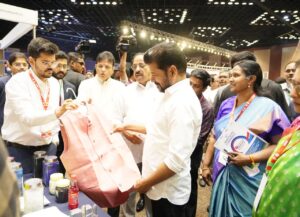
He also highlighted the convergence of textiles with other industries, particularly the film sector. “Hyderabad is now a global film production hub,” he said, noting the presence of streaming giant Netflix’s Eyeline Studios in the city. With Tollywood, Bollywood, and now Hollywood projects based in Hyderabad, the government plans to encourage the film industry to source costumes and fashion locally.
A major focus area outlined by the Chief Minister was sustainability. He announced plans to establish green textile hubs that prioritize eco-friendly manufacturing practices and environmental conservation. This initiative aligns with global trends toward sustainable fashion and responsible production.
The government also plans to invest heavily in skill development, particularly targeting women in the workforce. By integrating traditional weaving expertise with modern technologies in design, cutting, and stitching, Telangana aims to create a future-ready textile workforce.
Drawing parallels with Telangana’s success in pharmaceuticals and vaccine production, Revanth Reddy said the state has already proven its capability to serve global markets. He cited the example of Telangana emerging as a manufacturing hub for Apple AirPods, signaling its growing strength in advanced manufacturing.
“Just as we produce medicines for the world, we now aim to manufacture fashion for the world,” he declared.
The ATEXCON 2026 conference, themed “Reimagining the Future of Global Textiles,” will feature discussions on key areas such as fibres and fabrics, AI-driven manufacturing and supply chains, and global trade and market trends.
With a clear roadmap, strong policy backing, and a blend of tradition and innovation, Telangana is positioning itself as a formidable player in the global textile landscape.