

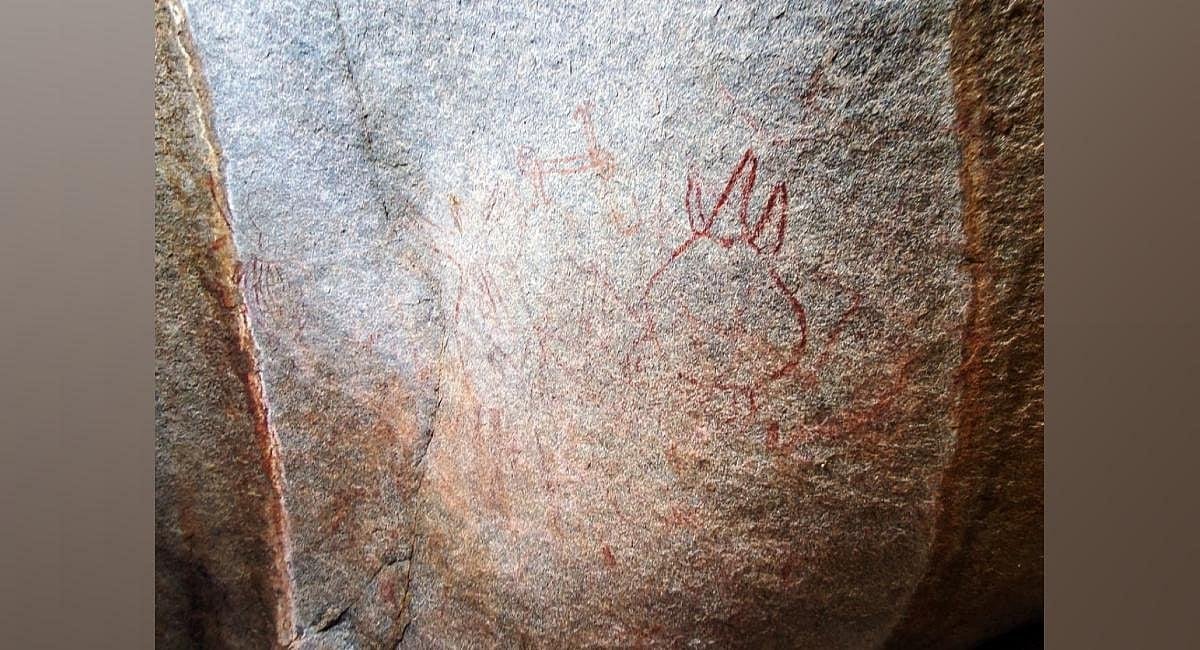
Faded red scripts believed to belong to the 1st-century Brahmi and 7th-century Telugu-Kannada periods have been identified near Forest Trek Park, adding another chapter to the city’s rich archaeological heritage.
HYDERABAD, November 21, 2026: Hyderabad’s outskirts have once again drawn attention to the region’s remarkable historical past. Researchers and heritage enthusiasts have identified ancient red-coloured inscriptions on a rock shelter near Manchirevula Forest Trek Park, in a discovery that could offer fresh insights into the history of human settlements in the Deccan region.
The inscriptions were found on a boulder wall beneath a natural rock shelter on a hill adjacent to the Ghar-e-Mubarak Dargah hill. The location is close to Manchirevula Forest Trek Park, an area that has already attracted archaeological interest following earlier discoveries of prehistoric rock paintings and stone tools.
The latest discovery was made by members of the Kotha Telangana Charitra Brundam, along with representatives of Save Rocks and Climate Front Telangana. Kavali Chandrakanth of the Kotha Telangana Charitra Brundam identified the site. Subsequently, the group, including its president Sriramoju Haragopal, Climate Front Telangana vice-president Mir Omar Ali Khan, Siddhartha and Dr Sudhir Bhanu of Save Rocks, visited the location to examine the markings and study the surviving inscriptions.
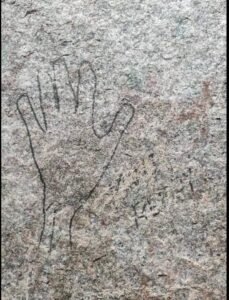
Two ancient scripts, separated by centuries
According to Sriramoju Haragopal, the visible remnants appear to represent two different historical script traditions. Some portions have been identified as belonging to the 1st-century Brahmi script, while another portion is believed to be associated with the 7th-century Telugu-Kannada script.
The surviving markings reportedly include fragments interpreted as “Vi”, “Ta”, “Tarah”, “(Ku)shta Charu” and “Duru”. However, much of the original pigment has faded, making it difficult to read the complete text or establish its precise meaning.
Researchers believe that the inscriptions are particularly significant because they appear to be written characters rather than conventional rock paintings. Their presence may point to different phases of human activity and the use of written symbols in the area over several centuries.
Rainwater has washed away a considerable portion of the red pigment, leaving only fragments visible on the rock surface. Further documentation, detailed examination and expert interpretation will be necessary to establish the inscriptions’ full historical context.
A landscape that preserves prehistoric memories
Manchirevula’s archaeological importance is not limited to this latest discovery. In October 2023, researchers identified prehistoric rock paintings at the Forest Trek Park, depicting three tortoises, a fish and a geometric motif in red pigment.
Following a preliminary study, these paintings were associated with the Mesolithic period, with an estimated age of approximately 6,000 to 12,000 years. The discovery was made by trekkers Mir Omar Ali Khan and Rishabh Manda, and subsequently examined by a team led by Dr M.A. Srinivasan, an assistant professor at Potti Sreeramulu Telugu University.
The presence of quartzite fragments and microliths—small stone tools associated with prehistoric communities—also added to the archaeological significance of the location. These findings suggested that the surrounding landscape may once have supported communities that depended on nearby natural resources for food and shelter.
The distinction is important: the prehistoric paintings belong to a much earlier period, while the newly identified inscriptions are believed to represent later historical phases.
Hyderabad’s heritage needs protection
The Manchirevula discoveries highlight how much of Hyderabad’s history remains hidden beyond its well-known monuments, forts and historic neighbourhoods. The region’s granite hills, natural rock shelters and forest landscapes may preserve valuable evidence of prehistoric life and early historical communities.
However, such heritage sites are vulnerable to weathering, human interference and the pressures of urban expansion. Earlier reports have also raised concerns about damage to ancient rock art due to vandalism and careless visitor activity.
The latest discovery underlines the need for systematic archaeological surveys, scientific documentation and appropriate conservation measures. Experts and heritage groups have repeatedly stressed the importance of protecting such locations so that future generations can understand and appreciate the region’s past.
For a city widely recognised for its modern IT corridor, historic monuments and rapid urban growth, Manchirevula offers a fascinating reminder that Hyderabad’s story began long before the modern metropolis took shape.
The faded red markings on a rock shelter may appear modest at first glance, but they could hold clues to centuries of human activity. With further research and conservation, the hills around Manchirevula may reveal even more chapters of Telangana’s forgotten history.