

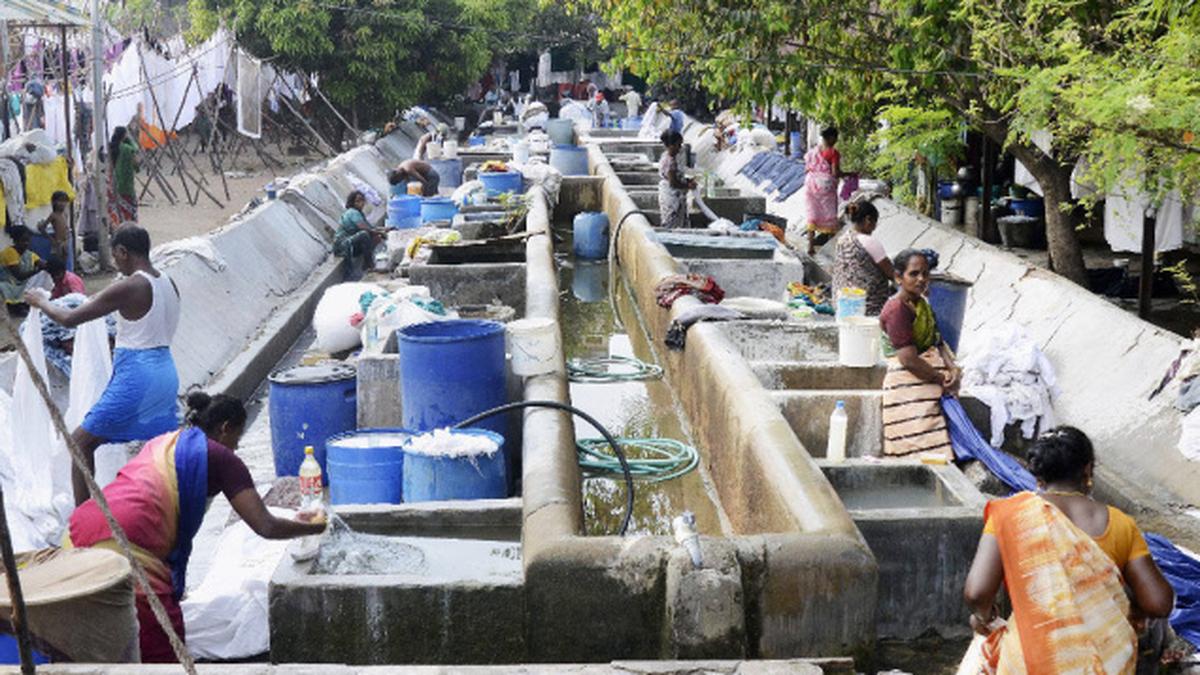
The Telangana Government has officially issued orders to add “Dhobi” as a synonym for the Rajaka/Chakali community while deleting the word “Vannar” from the State list of Backward Classes, marking a significant administrative and social decision concerning caste nomenclature and community identity in the state.
The Backward Classes Welfare (B) Department issued G.O. Ms. No. 7 dated May 23, 2026, amending the existing backward classes list under Group-A. The order modifies the entry at Serial No. 5, which earlier read “Rajaka (Chakali, Vannar),” and replaces it with “Rajaka, Chakali, Dhobi.”
According to the Government Order, the Telangana Commission for Backward Classes examined representations seeking the inclusion of “Dhobi” as a commonly used synonym and the deletion of “Vannar” from the official classification. The Commission, during its meeting held on May 12, 2025, reviewed requests submitted by community representatives and examined the socio-linguistic relevance of the terminology currently in use.
The Commission reportedly observed that the term “Dhobi” is widely recognized and socially used across Telangana to refer to members of the Rajaka/Chakali community. Based on this observation, it recommended that the term be officially incorporated into the backward classes list to align government records with prevailing social usage.
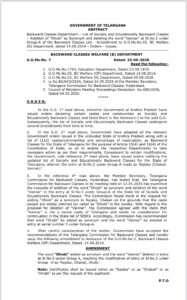
At the same time, the Commission recommended the removal of the word “Vannar,” stating that it is “not a native caste of Telangana” and therefore does not require continuation in the State list of Socially and Educationally Backward Classes (SEBCs). The recommendation was subsequently accepted by the State Government after detailed consideration.
The amendment has administrative implications as well. The order clearly states that caste certificates can now be issued using any one of the officially recognized names — “Rajaka,” “Chakali,” or “Dhobi” — depending on the preference of the applicant. This is expected to simplify documentation processes and reduce discrepancies in caste certificates, educational records, employment applications, and welfare-related documentation.
The Government has also directed the General Administration Department to make corresponding amendments in the Telangana State and Subordinate Service Rules, 1996. In addition, the Chief Commissioner of Land Administration has been instructed to issue guidelines to all District Collectors, Revenue Divisional Officers, and Tahsildars for implementing the revised nomenclature while issuing caste and community certificates.
Officials from the Backward Classes Welfare Department said the amendment is aimed at bringing clarity and uniformity in official records while reflecting terms that are more commonly used and socially identifiable within Telangana society.
The order has sparked wider public discussion on caste terminology, regional identity, and the role of language in official classification systems. While “Vannar” is a term historically associated with washerfolk communities in parts of South India, particularly Tamil-speaking regions, the Telangana Commission for Backward Classes concluded that the nomenclature does not reflect a native caste identity within Telangana’s socio-cultural framework.
Community members and social observers view the move as an attempt to standardize caste nomenclature in a way that aligns with local usage patterns. Some believe the inclusion of “Dhobi” may help avoid confusion in interstate migration and central-level documentation, where the Hindi term is more widely recognized.
The Government Order references earlier notifications issued both during the undivided Andhra Pradesh era and after the formation of Telangana. It also notes that the backward classes list has undergone several amendments over time in response to changing administrative and social requirements.
The order was issued by Principal Secretary to Government (FAC) B. Bala Maya Devi in the name of the Governor of Telangana and has been circulated to all concerned departments, district administrations, commissions, universities, and public institutions for immediate implementation.
The latest amendment reflects Telangana Government’s continuing exercise of revisiting caste classifications and nomenclature within the framework of backward class welfare and administrative reforms.