

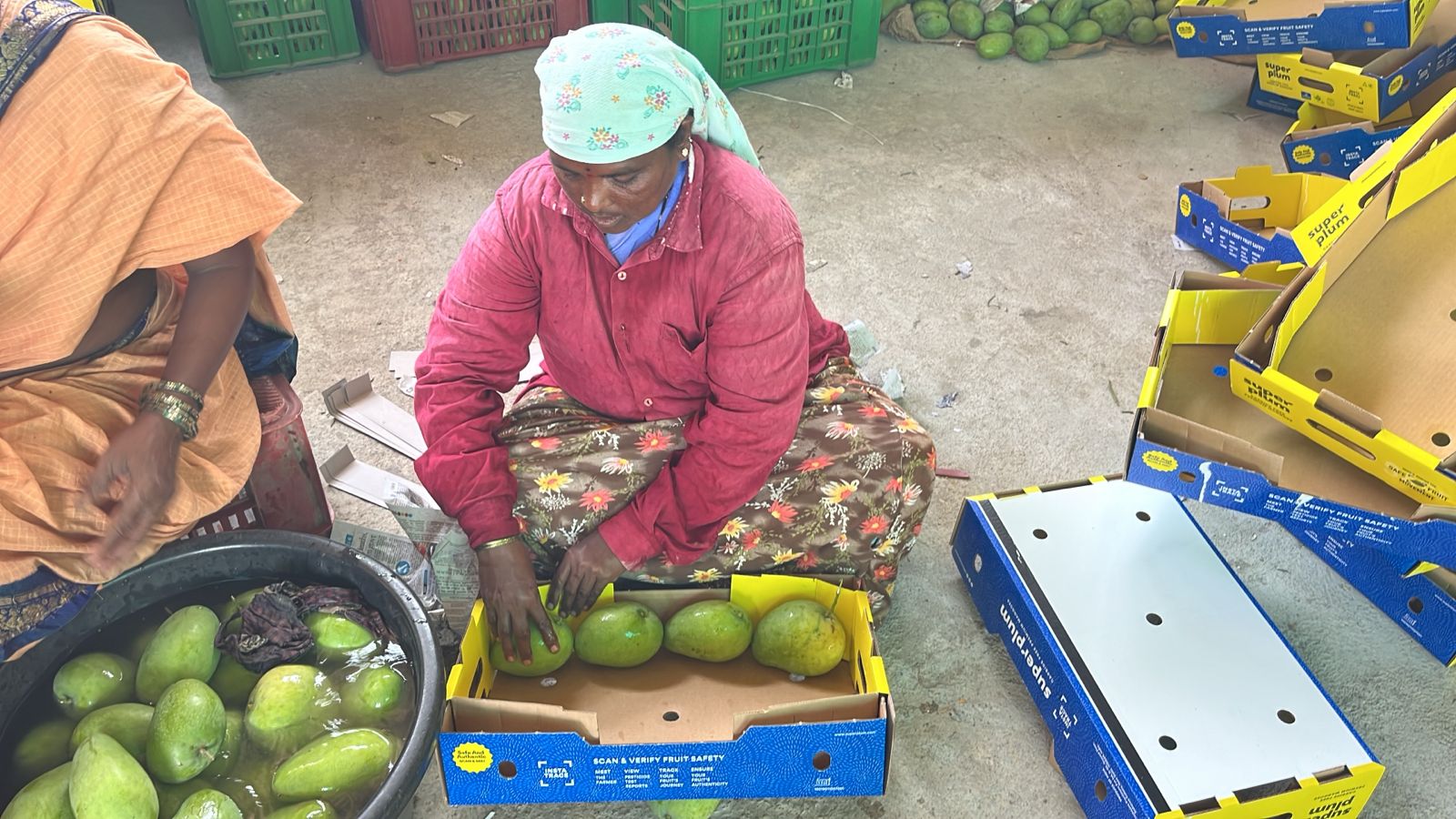
Hyderabad: In a remarkable example of grassroots economic transformation, a small mango farmer from Pebbair village in Wanaparthy district has achieved what once seemed unimaginable — exporting Mallika mangoes to international markets. Though the shipment consisted of only eight crates, the development marks a historic milestone in Telangana’s evolving rural economy and highlights the growing strength of women-led agricultural institutions across the state.
Behind this achievement lies a larger story of empowerment, collective enterprise, and rural innovation driven by women Self-Help Groups (SHGs) and Farmer Producer Organisations (FPOs) under the guidance of Telangana’s Panchayat Raj and Rural Development Minister Danasari Anasuya Seethakka.
Over the past few years, Telangana has emerged as a model for community-driven agricultural transformation, where women are no longer confined to traditional savings groups or support networks. Instead, they are taking leadership roles as agri-entrepreneurs, exporters, supply-chain coordinators, and business managers, creating new opportunities for thousands of small and marginal farmers.
At the center of this transformation is the Be’nishan Federation, a women-supported network comprising 84 Farmer Producer Organisations spread across 30 districts of Telangana. The federation has become a powerful bridge connecting rural farmers directly to domestic retail giants, food processing industries, and global export markets.
What makes this initiative especially significant is its focus on small and marginal farmers who traditionally struggled with low bargaining power, exploitation by middlemen, delayed payments, and lack of market access. Through collective marketing and institutional support, these farmers are now receiving fair prices, timely payments, and access to larger commercial ecosystems that were previously beyond their reach.
According to official figures, the Be’nishan Federation and associated FPOs have already generated cumulative business worth ₹463 crore. More than 1.09 lakh small and marginal farmers have been integrated into the network, creating one of the largest community-driven agricultural marketing ecosystems in the state.
Farmers associated with the initiative are reportedly earning 15 to 20 percent higher incomes compared to traditional market channels. Another major relief for rural producers is the quick settlement system, with payments often being cleared within just two days — a major improvement in a sector where delayed payments are common.
The Telangana produce marketed through these networks now reaches some of India’s biggest retail and e-commerce platforms, including Reliance Retail, Flipkart, BigBasket, Metro Cash & Carry, More Retail, and Star Bazaar, while export opportunities are steadily expanding into overseas markets.
The mango export from Wanaparthy symbolizes much more than a successful trade transaction. It reflects the growing confidence among rural women and small farmers who are increasingly adopting scientific farming methods, quality-control systems, and export-oriented agricultural practices.
Women-led SHGs and FPOs are now actively involved in every stage of the agricultural value chain — from scientific harvesting and post-harvest management to grading, sorting, packaging, branding, and logistics. Training programs and institutional support have enabled rural women to understand international quality standards and market requirements, helping Telangana’s produce compete in highly competitive markets.
The success also demonstrates the effectiveness of collective farming and cooperative market structures in strengthening rural economies. By aggregating produce through FPOs, small farmers who individually lack scale are now able to fulfill bulk orders from large retailers and exporters. This collective strength has significantly improved their negotiating power and reduced dependence on intermediaries.
Officials associated with the rural development ecosystem believe the initiative is helping create sustainable livelihoods while also reducing migration pressures from rural areas. The economic participation of women has particularly contributed to stronger household incomes, improved financial independence, and enhanced social status for women in villages.
Beyond economics, the movement is also reshaping perceptions about rural women’s capabilities. Telangana’s women are proving that they can successfully manage sophisticated agricultural enterprises and compete in national and global supply chains with professionalism and efficiency.
The transformation unfolding in Telangana reflects a broader shift in rural India, where women-led community institutions are emerging as engines of inclusive growth and agricultural modernization. The export of a few crates of mangoes from a remote village may appear modest on the surface, but it carries a much larger message — that even the smallest farmers can access global opportunities when empowered through organisation, training, and collective action.
From village orchards to international shelves, Telangana’s women are cultivating far more than premium mangoes. They are nurturing confidence, dignity, entrepreneurship, and a new identity for rural communities determined to participate in the global economy.