

“I listened, motionless and still, and as I mounted up the hill,
the music in my heart I heard, long after it was heard no more.”
— William Wordsworth
Few journeys in India capture romance, nostalgia, history, and natural splendour quite like the legendary Kalka–Shimla toy train ride. Winding gracefully through misty mountains, deep valleys, whispering pine forests, and charming hill stations, this UNESCO World Heritage rail route remains one of the most captivating travel experiences in the country.
Indian Railways proudly proclaims that it transports “an Australia” every day on its vast network — no mean feat. In an era where airlines and highways lure travellers with speed and convenience, rail journeys still possess a timeless magic. Nowhere is this charm more evident than on the narrow-gauge railway from Kalka to Shimla, where every bend reveals breathtaking Himalayan vistas and echoes of a glorious past.
For generations of travellers, train journeys have offered far more than transportation. They unveil landscapes slowly and intimately — steep mountain slopes, narrow valleys, dense forests, and sleepy settlements unfolding like scenes from a moving canvas. The Kalka–Shimla rail line exemplifies this old-world charm.
Shimla, once the Summer Capital of British India, has also witnessed significant moments in history. In 1945, Lord Wavell held crucial discussions here regarding the Cabinet Mission Plan during India’s freedom struggle. Twenty-seven years later, on 2 July 1972, Prime Minister Indira Gandhi and Pakistan’s President Zulfikar Ali Bhutto signed the historic Shimla Agreement following the 1971 Indo-Pak war that led to the birth of Bangladesh.
Today, the “Queen of Hills” remains one of India’s most beloved mountain destinations. Nestled at an altitude of 2,213 metres in the north-western Himalayas, Shimla continues to enchant visitors with its colonial architecture, pleasant climate, and scenic beauty.
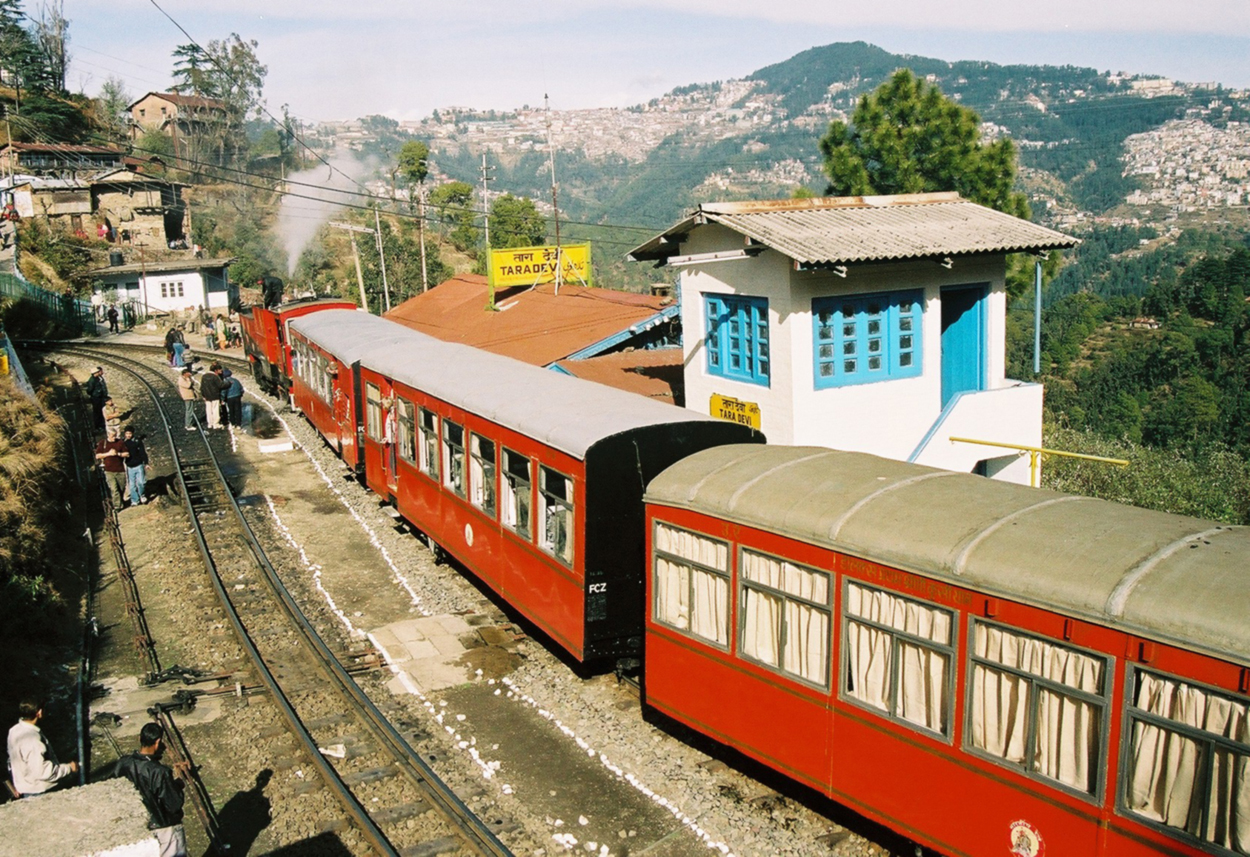
The 96-kilometre Kalka–Shimla railway line, a remarkable engineering achievement of the British era, traverses over 889 bridges and passes through 102 tunnels carved into the Shivalik Hills. The route, now recognised as a UNESCO World Heritage Site, offers travellers an unforgettable experience as the toy train climbs rhythmically through Dharampur, Solan, Kandaghat, Barog, Tara Devi, Summer Hill, and finally Shimla.
The Barog Tunnel: A Tragic Tale Beneath the Hills
Among the many fascinating stops along the journey, Barog stands out for both its beauty and its haunting history. Tourists often pause here to savour hot parathas, cutlets, fried eggs, and steaming tea amid cool mountain breezes and chirping birds.
The famed Barog Tunnel — Tunnel No. 33 — is the longest on the route and is associated with a tragic story. Colonel Barog, the British engineer overseeing its construction, attempted to speed up the work by excavating the tunnel simultaneously from opposite ends of the mountain. According to his calculations, the two ends would meet perfectly at the centre.
However, due to a grave miscalculation, the tunnel alignment went disastrously wrong. The two ends never met. The blunder caused immense financial losses, and the British government imposed a heavy penalty on Colonel Barog for the wastage of public funds. Humiliated and devastated, the Colonel eventually took his own life near the incomplete tunnel.
Today, the tunnel stands not only as an engineering marvel but also as a poignant reminder of human ambition and tragedy.
Several trains ply this picturesque route, including the Kalka–Shimla Express, Himalayan Queen, and Shivalik Deluxe Express. The slow ascent through mist-covered mountains and dense forests leaves an indelible impression on every traveller fortunate enough to undertake the journey.
Shimla itself offers countless attractions — Summer Hill, the Indian Institute of Advanced Study, Annandale, Jakhoo Temple, Tara Devi Temple, Viceregal Lodge, Gaiety Theatre, and nearby Kufri among them. Whether in summer sunshine or winter snowfall, a leisurely walk along the iconic Mall Road with a steaming cup of coffee remains an essential Shimla experience.
Though thousands arrive in Shimla by road and air, the rail journey retains an irreplaceable allure. Clouds drifting through the train windows, forests brushing past the coaches, and the rhythmic clatter of wheels over mountain tracks create memories that linger forever.
Indeed, the Kalka–Shimla rail journey is not merely travel — it is poetry in motion.
“Trains are wonderful… To travel by train is to see nature and human beings, towns and churches and rivers — in fact, to see life.”
— Agatha Christie
ABOUT THE AUTHOR

Ravi Valluri is Advisor, Krishnapatnam Railway Company Limited. He has authored both fiction and non-fiction work and is a faculty of the Art of Living. His latest work is Sita to Abhaya: Have Things Changed? He can be reached at valluri.ravi@gmail.com or WhatsApp at 9618564024.