

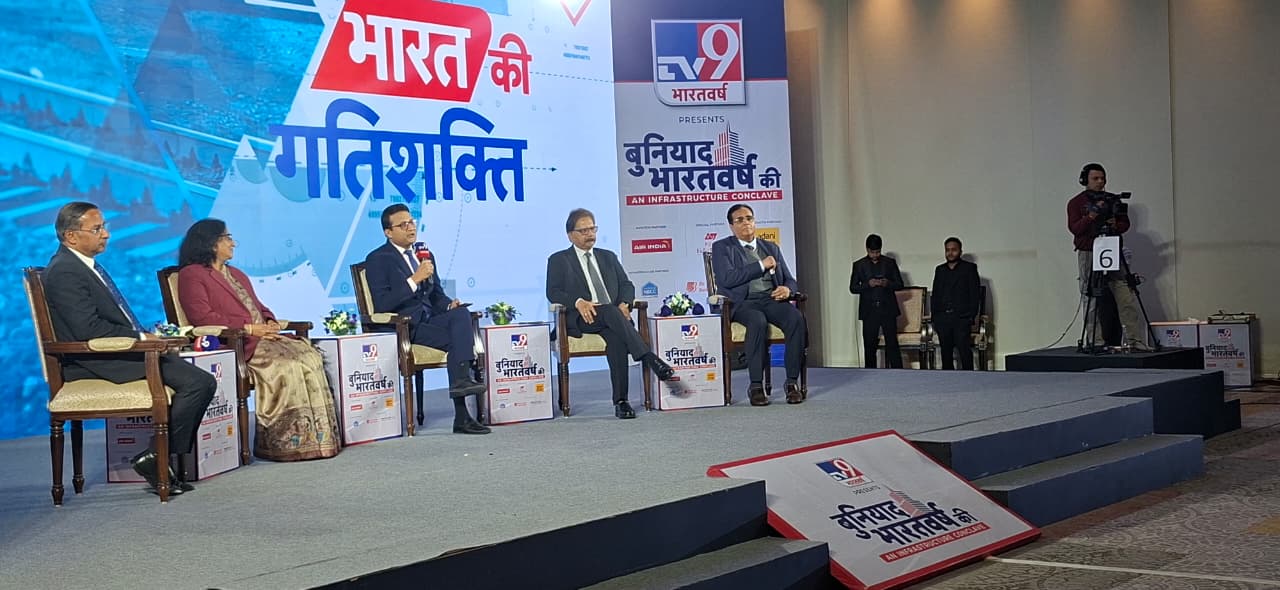
New Delhi: At the “Buniyaad Bharatvarsh Ki – An Infrastructure Conclave” hosted by TV9 Bharatvarsh, Ravi Valluri—Advisor to Krishnapatnam Railway Company Limited, author and faculty member of Art of Living—shared key insights on the most pressing challenges facing Indian Railways as the country advances toward Mission 2047.
Responding to a question from the anchor on the biggest hurdle before Indian Railways today, Valluri underlined that network congestion remains the single largest bottleneck affecting punctuality, capacity, and economic efficiency.
Quoting Prime Minister Narendra Modi, Valluri said that transforming the lives of people in villages through better roadways, railways, highways and airways has been a core vision of the government. To address these challenges, he noted, Indian Railways initiated the National Rail Vikas Yojana, with a clear focus on decongesting high-density routes.
At the “Buniyaad Bharatvarsh Ki – An Infrastructure Conclave” hosted by TV9 Bharatvarsh, Ravi Valluri—Advisor to Krishnapatnam Railway Company Limited, author and faculty member of Art of Living—shared key insights on the most pressing challenges facing Indian Railways as the… pic.twitter.com/ULNDOxzfn6
— Telangana Trends (@TGStateTrends) December 23, 2025
Drawing from his professional experience, Valluri highlighted his association with major rail infrastructure projects such as Chhattisgarh East Railway Limited and Chhattisgarh East-West Railway Limited, where nearly 350 km of dedicated rail corridors are under development. These corridors, similar to Dedicated Freight Corridors, are expected to significantly decongest critical routes like the Mumbai–Howrah section, thereby enabling smoother operations of mail and express passenger trains.
He pointed out that once freight traffic is shifted to dedicated corridors, long-standing public complaints regarding train delays and poor punctuality will be substantially resolved. Citing an operational example, Valluri recalled that during his tenure around the Mughal Sarai (now Pt. Deen Dayal Upadhyaya) section, the daily handling capacity improved from 40 to 65 trains, while punctuality in the Prayagraj Division rose dramatically to 95 percent, compared to nearly 30 percent earlier.
Valluri emphasized the economic impact of improved rail efficiency, noting that transporting 150 million tonnes of coal from resource-rich regions could add immense value to the national economy and boost industrial productivity.
On the investment front, he referred to Union Minister Jyotiraditya Scindia, who had earlier highlighted that capital expenditure on rail and infrastructure touched nearly ₹11 lakh crore last year, compared to around ₹2 lakh crore during the UPA period, with further increases expected in the current fiscal.
Currently serving as Advisor at Krishnapatnam Railway Company Limited, Valluri strongly advocated the SPV (Special Purpose Vehicle) and Joint Venture models as effective tools to accelerate infrastructure development. He explained that rail links connecting ports such as Krishnapatnam Port to inland divisions like Guntakal in South Central Railway are already handling 23–24 million tonnes of cargo, demonstrating the success of commodity-specific dedicated corridors.
According to him, the expansion of SPV-led projects will not only improve freight movement but will also automatically enhance passenger train speeds by freeing up existing tracks. Addressing seasonal challenges such as fog in North India, Valluri said decongestion remains the most effective long-term solution to ensure punctual operations.
He concluded by stating that dedicated corridors, higher capital investment, and SPV-based execution models together form the backbone of Indian Railways’ journey toward a faster, more reliable, and economically transformative future in line with Mission 2047.