

Hyderabad: In a historic and far-reaching administrative reform, the Telangana government under the leadership of A. Revanth Reddy has bifurcated the Greater Hyderabad Municipal Corporation (GHMC) into three independent civic bodies, marking a decisive shift toward decentralised, responsive, and citizen-centric urban governance.
The move, widely seen as one of the most significant urban reforms since the formation of Telangana, aims to address the challenges posed by Hyderabad’s rapid urbanisation, population growth, and expanding metropolitan footprint.
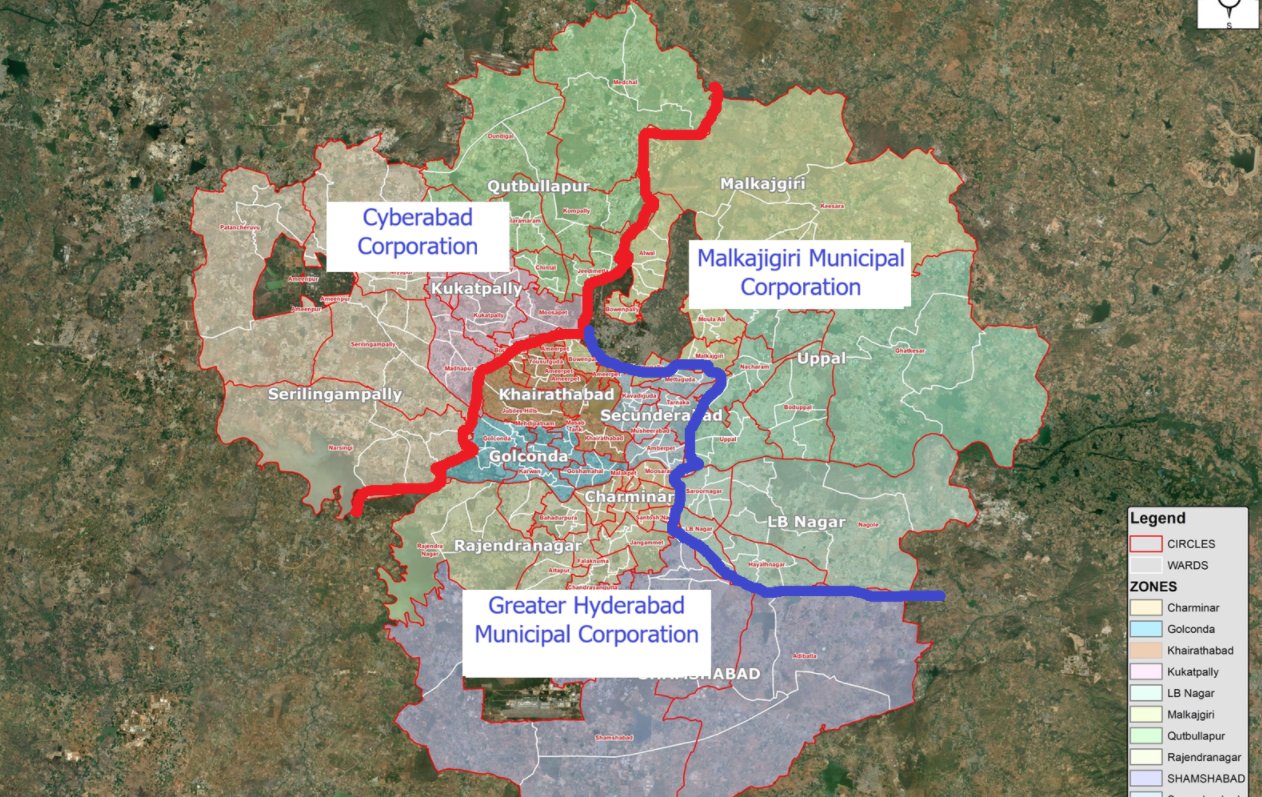
Under the new structure, the existing GHMC will function alongside two newly created corporations:
- Cyberabad Municipal Corporation (CMC)
- Malkajgiri Municipal Corporation (MMC)
This restructuring reflects the Revanth Reddy government’s clear policy intent: governance must evolve with the city, not lag behind it.
A Strategic Shift Toward Decentralisation
For years, GHMC—one of India’s largest municipal bodies—has struggled with scale. Managing infrastructure, sanitation, town planning, traffic coordination, and civic services for a vast and diverse urban population from a single administrative framework increasingly proved inefficient.
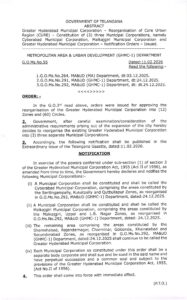
Recognising this, the state government initiated the bifurcation under Section 3(1) of the GHMC Act, 1955, following a comprehensive delimitation exercise. The result is a leaner, more agile governance model designed to deliver faster decisions and improved accountability at the local level.
Officials noted that decentralisation will enable corporation-specific planning, allowing each civic body to focus on its unique urban character—be it the IT-driven growth corridors of Cyberabad, the dense residential zones of Malkajgiri, or the heritage and administrative core under GHMC.
Expanded Civic Representation: 300 Divisions
As part of the reform, the total number of civic divisions across the three corporations has been increased to 300, ensuring better representation and closer administrative reach.
- Original GHMC divisions: 150
- Expanded to 243 after delimitation
- 57 new divisions added from newly merged municipalities and corporation areas
This expansion strengthens grassroots governance, giving corporators and officials a more manageable population base, which is expected to significantly improve service delivery and grievance redressal.
Clear Jurisdiction, Focused Development
The territorial distribution has been carefully designed to reflect natural urban clusters:
- GHMC: Shamshabad, Rajendranagar, Charminar, Golconda, Khairatabad, Secunderabad
- Cyberabad Municipal Corporation (CMC): Serilingampally, Kukatpally, Quthbullapur
- Malkajgiri Municipal Corporation (MMC): Malkajgiri, Uppal, LB Nagar
This clarity of jurisdiction is expected to eliminate administrative overlap, improve coordination with line departments, and accelerate infrastructure projects tailored to local needs.
Strong Administrative Oversight During Transition
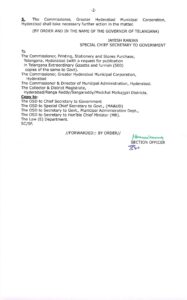
To ensure a smooth and coordinated transition, the government has appointed commissioners for all three corporations and issued formal operational orders. Additionally, Jayesh Ranjan, Special Chief Secretary (MA&UD), has been designated as Special Officer to oversee and synchronise the functioning of all three civic bodies during the transition phase.
This oversight mechanism underlines the government’s seriousness in ensuring that reform translates into results, not confusion.
Revanth Reddy Government’s Reformist Imprint
Urban policy experts see this move as emblematic of the Revanth Reddy government’s broader governance philosophy—institutional reform over cosmetic change. By tackling structural issues head-on, the government has sent a strong signal that Telangana’s urban future will be shaped by planning, decentralisation, and accountability.
With Hyderabad emerging as one of India’s fastest-growing metropolitan regions and a global investment destination, officials believe that three focused civic bodies will:
- Improve infrastructure execution
- Enhance financial discipline
- Enable faster approvals
- Bring administration closer to residents
The bifurcation of GHMC is not merely an administrative exercise—it is a bold reset of urban governance, positioning Hyderabad for its next phase of sustainable and inclusive growth.