

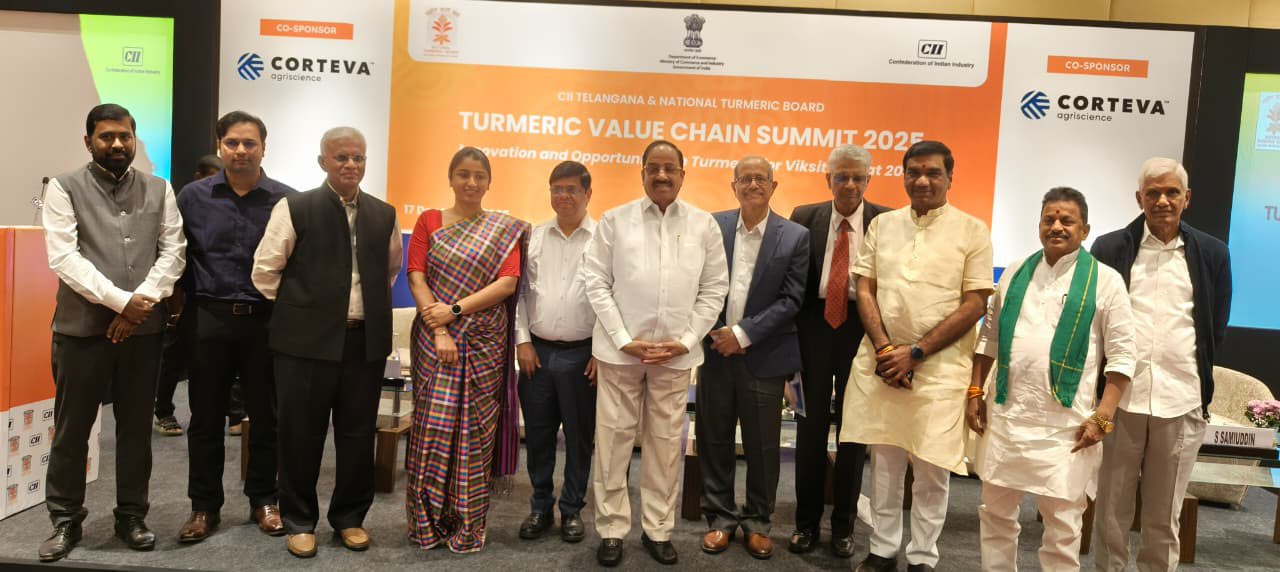
Hyderabad | December 17, 2025: The Turmeric Value Chain Summit–2025, held in Hyderabad, emerged as a significant platform to deliberate on farmer-centric reforms, sustainable pricing, value addition and export orientation for India’s turmeric sector. Addressing the summit, Hon’ble Minister for Agriculture Tummala Nageswara Rao asserted that the welfare of turmeric farmers must form the very foundation of policy formulation, pricing mechanisms and market reforms.
The summit was jointly organised by Confederation of Indian Industry (CII) Telangana and the National Turmeric Board, bringing together policymakers, agricultural scientists, industry leaders, exporters and farmer representatives from across the country.
Telangana’s Strategic Role in Global Turmeric Leadership
India continues to lead the world in turmeric production, and Telangana has emerged as one of the most critical contributors. The Minister highlighted that Nizamabad and Armoor have developed into major turmeric hubs, known nationally and internationally for both volume and quality.
The Geographical Indication (GI) tag accorded to Armoor Turmeric, he said, is a recognition of the region’s agro-climatic suitability, traditional cultivation practices and the relentless hard work of Telangana’s farmers. The GI status also provides a strong foundation for branding, traceability and premium pricing in global markets.
Agri Vision 2047: Agriculture as an Engine of Growth
Referring to Agri Vision 2047, announced during the Telangana Rising Global Summit, the Minister underlined that agriculture in Telangana is being repositioned as an engine of economic growth rather than merely a welfare-driven sector. Within this long-term vision, turmeric has been identified as a strategic crop with high potential for value addition, exports and farmer income enhancement.
Price Volatility a Major Concern
The Minister expressed serious concern over price volatility in turmeric markets, warning that unstable prices are discouraging farmers from continuing cultivation. He pointed out that the cost of cultivation currently ranges between ₹8,000 and ₹9,000 per quintal, while market prices hover around ₹12,000 per quintal, leaving farmers vulnerable to market fluctuations and rising input costs.
“Sustainable and remunerative pricing is essential to maintain farmer confidence and ensure continuity of cultivation,” he said, calling for immediate policy interventions.

National Turmeric Board: From Offices to Fields
Emphasising the role of the National Turmeric Board, the Minister stated that the Board must function as a farmer-centric policy institution, extending its engagement beyond offices into the fields. Its responsibilities, he said, include ensuring remunerative prices, protecting farmer interests and strengthening India’s leadership in global turmeric trade.
Key focus areas identified for the Board include:
- Farmer welfare and income security
- Research-to-field adoption of technologies
- Marketing, branding and global positioning
- Export leadership and market diversification
To address market instability, the Minister called for the introduction of price stability mechanisms, advance market intelligence systems, transparent trading platforms and uniform moisture and quality standards across markets.
Making Telangana Turmeric Globally Competitive
To enhance global competitiveness, the Minister stressed the need to focus on high-curcumin turmeric varieties, establishment of quality testing and certification laboratories, and alignment with international quality and safety standards. These measures, he said, are essential to meet the demands of global buyers and high-value markets.
Integrated Farming and Value Addition
Under the Integrated Farming framework of Vision 2047, turmeric can be promoted as an intercrop, particularly in oil palm plantations. This approach, the Minister noted, enables better land utilisation, reduces crop risk and significantly improves farmer incomes.
He further urged farmers and stakeholders to move beyond raw turmeric sales and focus on value addition, stating that the future of the turmeric sector lies in processed and value-based products. Priority areas highlighted include:
- Processing and aggregation centres
- Nutraceuticals and immunity-boosting products
- Cosmetics and wellness products
- Curcumin extraction and pharmaceutical applications
Way Forward
The Turmeric Value Chain Summit–2025 concluded with a strong consensus that farmer-centric reforms, value addition, scientific cultivation practices and export-oriented strategies are essential to unlock the full potential of the turmeric sector. Stakeholders agreed that with coordinated efforts between government, industry and farmers, turmeric can play a transformative role in achieving the goals of Agri Vision 2047, while ensuring sustainable livelihoods for farmers and strengthening India’s position as the global turmeric leader.