

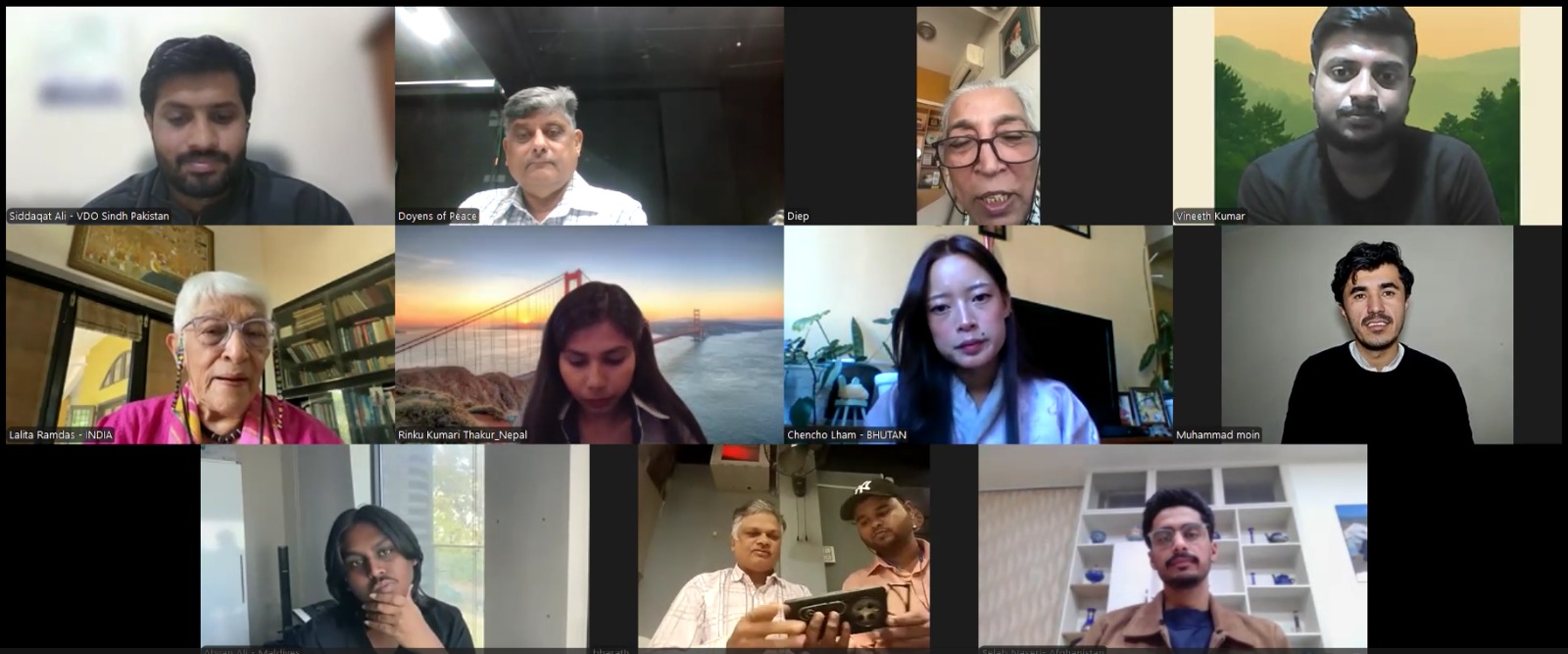
Hyderabad: In a powerful demonstration of regional solidarity and youth leadership, Doyens of Peace, a Pan-South Asia platform comprising civil society organisations and youth groups, commemorated SAARC Charter Day on 8 December 2025 with an innovative digital event centered around the theme:
“How Can Youth Collaborate Across Borders to Reduce Poverty and Promote Peace in South Asia?”
The event received an overwhelming response from young people aged 15–25 across the eight South Asian nations, with 220 video submissions of 2–5 minutes each. Fourteen of the most impactful videos were showcased during a live-streamed event attended virtually by hundreds of youth, educators, peace-builders, diplomats, researchers and development practitioners.
The event also featured reflections from youth leaders below 30 years from all eight SAARC nations, followed by a high-level panel discussion titled:
“Translating Aspirations into Reality: The Way Forward for South Asia.”


Youth Panel Representation Across South Asia
- Afghanistan: Silab Naseri
- Bangladesh: Mizanur Rahman
- Bhutan: Chencho Lham
- India: S. Vineeth
- Maldives: Abhyan Ali
- Pakistan: Mohammad Moin
- Nepal: Rinku Kumari
- Sri Lanka: M. Fathima Nusaika
Mir Kashif (India) welcomed the participants and outlined the vision and programs of Doyens of Peace. Ms. Lalita Ramdas, former Chairperson of Greenpeace International, delivered a keynote reflection expressing deep appreciation for the initiative and emphasizing the powerful role of youth networks in shaping a peaceful South Asia.
The event concluded with Arya Goutham of Nepal, who presented the outcome of extensive youth deliberations—the Strategic 9-Point Youth Blueprint for Transforming South Asia, synthesized from the 220 submitted videos.


Strategic 9-Point Youth Blueprint for Transforming South Asia
- South Asian Youth Peace Network: A structural platform for long-term regional trust-building
- Music Unites: Cross-border cultural diplomacy
- Social Media & AI for Peace and Collaboration: A digital shield against hate; a bridge for cooperation
- Virtual Campuses & Open South Asian University: Education without borders
- Regional Youth Innovation Hub: Catalyzing entrepreneurship and knowledge exchange
- Youth-Led Cross-Border Trade Bridges: A digital marketplace enabling regional economic collaboration
- Green Energy Grid Initiative: Building a regional clean-energy ecosystem
- Joint Environmental and Resource Programs: Collective stewardship of shared ecologies
- Disaster Response as a Unifying Force: Operationalizing regional solidarity

A Roadmap for Regional Transformation
This blueprint emerges not as isolated proposals but as a cohesive and implementable vision, positioning South Asian youth as drivers of:
- Peace and trust-building
- Regional economic integration
- Climate resilience and sustainability
- Innovation and knowledge production
- Cross-border empathy and cultural harmony
The Blueprint reframes South Asia’s greatest challenge—fragmentation—as its greatest opportunity:
A unified, innovation-driven, youth-led region where poverty is not destiny and conflict is not inevitable.
Next Steps: Turning Vision into Action
Doyens of Peace announced plans to establish Thematic Community Working Groups to advance collaborative initiatives derived from the Blueprint, including:
- Education Across Borders
- Climate Change Partnerships
- Regional Youth Innovation Hub
- Social Media & AI for Peace Collaboration
These groups will bring together academics, entrepreneurs, youth leaders, technology experts, and civil society institutions—building a living laboratory for regional transformation.
About Doyens of Peace
With a mission to transform the grammar of interactions and collaborations among South Asian youth, Doyens of Peace seeks to foster trust, foster people-to-people connectivity, and establish a resilient regional ecosystem of peace-builders and social innovators.
– Bharatesh Kidambi
For Doyens of Peace – South Asia
Email: peacedoyenssouthasia@gmail.com
WhatsApp: +91 77310 64466